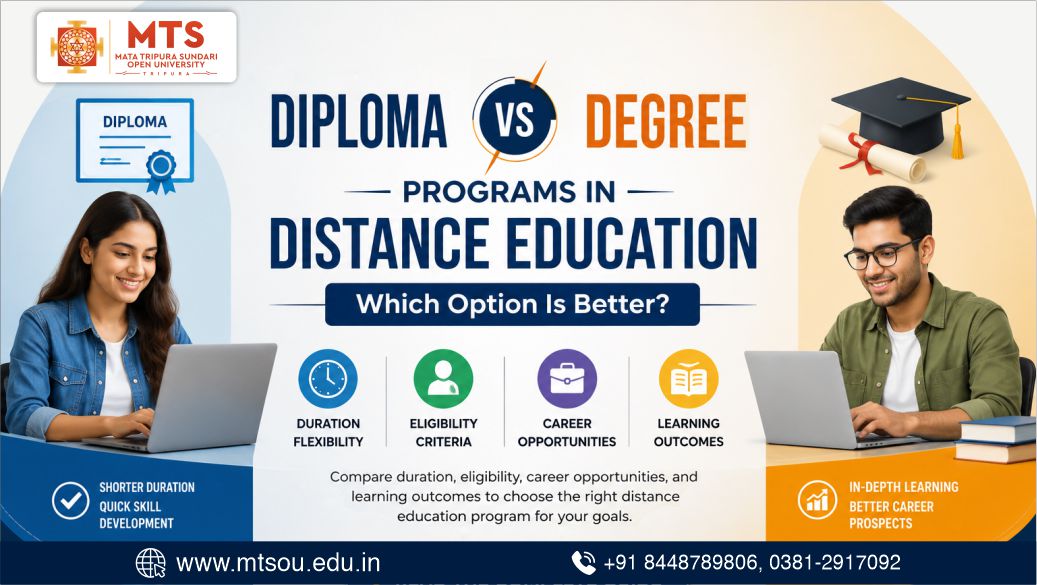
Diploma vs Degree Programs in Distance Education: Which Option Is Better?
Distance education has become a convenient, flexible, and accessible way to pursue higher education and professional development without any hassle. Whether you are a working professional or a student looking for learning opportunities, or someone seeking to upgrade skills without attending regular classes, distance education is the one to go.
However, one common question many learners face is: Should I choose a diploma program or a degree program in distance education?
The answer really depends on your career goals, educational background, budget and the amount of time you can dedicate to studies. To make a decision, here are 10 key factors that will help you determine which distance learning program is the right choice for you.
10 Key Factors to Consider When Choosing Between a Diploma & Degree Distance Learning Program
1. Understanding the Difference Between a Diploma and a Degree
Each qualification represents something that we should be aware of.
A diploma program is generally shorter and focuses on practical skills, industry-specific knowledge, and job-oriented training. A degree program provides an academic base and a deeper understanding of a subject.
If your goal is to acquire job skills quickly, a diploma may be suitable, but if you seek education and long-term career growth, a degree may be the better option. A degree program can provide you with an understanding of a subject.
2. Consider Your Career Goals
Your career aspirations should play a role in your decision.
Many entry-level and technical roles accept diploma holders in fields like Information Technology, Digital Marketing, Healthcare Support, Hospitality, and Business Administration. A diploma can help you get a job in these fields.
Read Also - Distance Education vs Regular Degree: Which is Better for Working Professionals?
However, many professional, managerial, and leadership positions require a bachelor's or master's degree. If you aim for leadership roles, government jobs, higher studies or specialized professions, a degree program can provide opportunities. A degree can open up career opportunities and greater professional recognition.
3. Duration of the Program
One of the differences between diploma and degree programs is the duration.
Diploma programs usually take 6 months to 2 years to complete. Degree programs generally take 3 to 4 years for undergraduate studies.
Students who need qualifications to quickly enter the workforce often prefer diploma programs because they are much shorter and also develops job-skills. Those willing to invest time for broader academic and career benefits may find degree programs more rewarding.
4. Cost and Affordability
Distance education is generally more affordable than classroom-based education, but diploma programs usually cost less than degree programs. If budget constraints are a concern, a diploma can be a way to gain valuable skills and improve employability. A diploma program is often cheaper.
However, a degree should be viewed as a long-term investment that may lead to earning potential and career advancement in the future. A degree program may be more expensive. It can result in better job prospects.
5. Emphasis on Academic Knowledge vs Practical Skills
Diploma courses provide hands-on training in applied knowledge that can foster skill development along with ready knowledge at workplace. Diploma course programs are industry-specific with greater job opportunities. The major difference between diploma and degree programs is that a diploma program is practical skill-oriented, whereas a degree program emphasises deeper knowledge of the concept.
Degree programs balance learning with research, critical thinking, analytical skills and theoretical knowledge. With the changing industry demands and focusing on professional career paths, the graduates can become job-ready and skilled.
6. Employment Opportunities
Employment can only be achieved after a Diploma or a degree program. The nature of opportunities may differ. A diploma may help you secure a job quickly in technical or vocational fields. A degree, however, is often preferred for positions involving management, administration, professional services and higher-level responsibilities.
7. Eligibility for Higher Education
If you plan to continue your education in the future, this factor is extremely important. Students with a degree program are eligible to take up higher studies like MBA, a postgraduate degree or can even explore employment opportunities abroad, whereas diploma holders need to acquire a degree program before becoming eligible for higher studies. For flexible and hassle-free education, a degree program can be opted.
Read Also - Open Distance Learning in India: A Smart Career Growth Option for Working Professionals
8. Credibility and Industry Recognition
Reputed universities and institutions hold more value when a degree or a diploma is obtained from them. Aspirants are recognised from premier institutes. However, some sectors emphasize degrees due to their comprehensive curriculum and academic rigour. A degree program is often preferred in industries.
9. Flexibility and Learning Requirements
Distance education is known for flexibility. Aspirants with a diploma or a degree program share different kinds of workload and responsibility. Diploma programs often involve subjects and a more focused curriculum, making them easier to manage alongside work or family commitments. A diploma program is flexible.
Degree programs require a commitment to assignments, projects, examinations and independent study. Students should realistically assess their time and ability to handle academic responsibilities before making a long-term decision.
10. Long-Term Career Growth
While a diploma can provide entry into the workforce, a degree often offers stronger long-term career prospects.
Degree holders may have access to paying positions, promotion opportunities and professional advancement over time. A degree program can provide long-term career growth.
Read Also - A Comprehensive Guide to Distance Education Programs in India
Why Choose MTS Open University for Distance Education Program?
Mata Tripura Sundari Open University is one such example of a top open university in India for offering diploma and degree programs with UGC-DEB Recognized courses to aspirants planning for such courses in their careers. Many professionals begin with a diploma. Later pursue a degree through distance education as their careers progress. A diploma can be a starting point, and a degree can be pursued later.
Conclusion
Both diploma and degree programs are fantastic opportunities for learners. People with a focus on practical skills and working in the field may prefer to obtain a diploma in order to gain these sorts of skills, industry training and quicker entry into the workforce, whereas those who want a broad academic base and more career options and better long-term career prospects may choose a degree.
Ultimately, the decision lies with what you want to do, how much you can afford, how much time you can dedicate, and future studies you may have in mind.

RECENT BLOGS
 BBA Distance Education: Complete Guide to Course, Benefits & Career Opportunities
BBA Distance Education is a flexible undergraduate management program for students who wish to pursue business administration
 Mizoram University ODL vs MTSOU ODL: Courses, Fees & Key Differences
Open and Distance Learning (ODL) has increasingly become a viable choice for those individuals desiring to pursue their
 Is It Better to Pursue a Distance MBA While Working? Benefits & Career Scope
While continuing education may not be an easy process especially when the learner has to attend classes regularly
