A BBA Distance Education programme consists of three years, but the actual flexible time may vary from institution to institution.
BBA Distance Education: Complete Guide to Course, Benefits & Career Opportunities
Table of Contents
BBA Distance Education is a flexible undergraduate management program for students who wish to pursue business administration without attending classroom-based programs of study. The course covers areas such as management, marketing, finance, human resources, business communication, and entrepreneurship. The length of time and eligibility for distance BBA vary from university to university and with the regulatory requirements in India.
Based on the University’s norms and rules, distance education allows students to study through online resources, self-learning materials, digital lectures, assignments, and examinations. The redefined programme structure offers an opportunity to gain business knowledge while managing other academic, professional, or personal commitments.
Before enrolling in a distance BBA programme, students should check whether the university and programme have the required recognition and approvals applicable to distance or open learning in India.
1. What Is BBA Distance Education and How Does It Work?
BBA Distance Education is an undergraduate management programme offered through a flexible learning option that sets aside the conventional daily classroom attendance. The BBA programme is primarily designed to outline the fundamental concepts related to communication, analytical skills, decision–making skills, etc.
Introduces students to fundamental concepts of business administration and helps develop managerial, analytical, communication, and decision-making skills.
Instead of attending classes every day on campus, students generally receive study materials and access to digital learning resources. Depending on the institution, these may include recorded lectures, online classes, e-learning portals, assignments, discussion forums, and other academic support services.
The distance-learning model can be particularly useful for students who want to continue working while pursuing a degree. It also offers greater flexibility in planning study schedules.
However, distance education requires self-discipline. Students need to regularly study their course material, complete assignments, prepare for examinations, and stay connected with the institution's academic resources.
Read Also - Is Open and Online Mode BBA Admission in India the Right Choice for You?
2. BBA Distance Education Course Details
| BBA Course Detail | Information |
|---|---|
| Programme | Bachelor of Business Administration (BBA) |
| Learning Mode | Distance / Flexible Learning |
| Duration | Generally 3 years |
| Eligibility | 10+2 or equivalent qualification |
| Key Subjects | Management, Marketing, Finance, HR, Business Communication, Economics |
| Learning Resources | Self-learning materials and digital resources, depending on the university |
| Career Areas | Marketing, HR, Finance, Sales, Operations, Business Development |
| Higher Education | MBA and other relevant postgraduate programmes |
BBA distance education courses after 12th are a three-year undergraduate programme, although the applicable maximum duration and academic structure can vary according to the university and regulatory framework.
The curriculum is designed to provide students with an understanding of how organisations operate and how different business functions contribute to organisational growth. Common subjects may include:
- Principles of Management
- Business Communication
- Financial Accounting
- Business Economics
- Marketing Management
- Human Resource Management
- Business Law
- Organisational Behaviour
- Business Statistics
- Operations Management
- Entrepreneurship Development
- Financial Management
- Management Information Systems
- Strategic Management
Some universities may also offer specialisations or elective subjects in areas such as Marketing, Finance, Human Resources, International Business, and Entrepreneurship.
Along with theoretical knowledge, students should focus on developing practical skills such as communication, presentation, teamwork, analytical thinking, problem-solving, and basic digital proficiency. These skills can strengthen their employability after graduation.
3. BBA Distance Education Eligibility
The eligibility criteria for BBA Distance Education vary by university. Generally, candidates who have completed their 10+2 or equivalent examination from a recognised board can apply.
Some institutions may have additional requirements relating to minimum marks, subjects, or documentation. Therefore, prospective students should carefully review the current admission notification and programme guidelines before applying.
Read Also - How BBA Distance Education Supports Flexible Learning and Career Growth
BBA Distance Education Admission Process
Step 1: Select a suitable university and BBA programme.
Step 2: Check the eligibility requirements and programme recognition.
Step 3: Complete the online application form.
Step 4: Upload the required academic and identification documents.
Step 5: Pay the applicable admission fee.
Step 6: Complete the verification or admission formalities prescribed by the university.
Step 7: After admission confirmation, access the learning portal and study materials.
Students should also compare factors such as curriculum, academic support, examination system, learning resources, fees, student services, and recognition before selecting an institution.
4. Top Benefits of Pursuing a BBA Through Distance Education
One of the biggest advantages of distance education is flexibility. In a BBA flexible learning programme, students can organise their study schedule around work, family responsibilities, competitive-exam preparation, or other commitments.
Flexible Learning
Students can study according to their own schedules rather than attending classes at fixed times every day. This can make the programme suitable for learners with busy routines.
Convenient Access to Education
Distance learning reduces the need for daily campus travel and allows students to access learning resources remotely, depending on the university's facilities.
Opportunity for Working Learners
Professionals can pursue an undergraduate management degree while continuing their employment. The combination of education and work experience may help learners understand business concepts from a practical perspective.
Development of Business Skills
A BBA introduces students to important areas such as marketing, finance, human resources, operations, management, and entrepreneurship. This broad exposure can help students identify their preferred career direction.
Cost and Time Convenience
Depending on the institution, distance education can be more economical than some traditional programmes. Students may also save on commuting and relocation expenses.
Foundation for Higher Education
A BBA can provide a foundation for postgraduate management education, including an MBA or other relevant master's programmes, subject to the eligibility requirements of the institution.
5. Career Opportunities After BBA Distance Education
Bachelor of Business Administration (BBA) is an amalgamation of business studies that include management subjects like Human Resources, Marketing, and Finance are different subject verticals that gives you a base understanding of the course altogether.
Marketing
BBA graduates can pursue roles such as Marketing Executive, Sales Executive, Digital Marketing Associate, or Business Development Executive. Developing knowledge of digital marketing, social media, analytics, and customer behaviour can improve career prospects.
Human Resources
Students interested in people management can explore roles such as HR Executive, Recruitment Associate, Talent Acquisition Executive, or HR Coordinator.
Finance and Banking
Graduates with an interest in finance may explore opportunities in banking, financial services, accounting support, and related business functions. Additional certifications and financial skills can further strengthen their profile.
Business Development
Business development professionals help organisations identify potential customers, build relationships, and contribute to revenue growth. Strong communication and negotiation skills are particularly valuable in this field.
Operations
BBA graduates can also pursue entry-level positions in operations, administration, supply chain, and customer relationship management.
Entrepreneurship
Students with an entrepreneurial mindset can use their business knowledge to establish and manage their own ventures. A BBA can provide exposure to areas such as finance, marketing, operations, and business planning.
6. Salary Prospects and Higher Education Options After BBA
Salary is one of the most important components that we all look forward to.Hence after pursuing BBA programme salary earnings are dependent upon aspirants how they perform during their service tenure.Fresh graduates typically begin with entry-level positions, while professionals can progress to higher responsibilities as they gain experience and specialised expertise.
There is a greater scope for higher education like MBA which can create a stable career in the long run. An MBA is one of the most popular choices for graduates who want to advance in management and leadership roles.
After completing a BBA, students can also pursue higher education. Other options may include postgraduate programmes, professional certifications, specialised diplomas, and skill-based courses.
Is Distance BBA course valid in India?
A distance BBA can be a valid undergraduate qualification provided the BBA is offered by an institution and programme which fulfils the relevant recognition and regulatory requirements. Prior to admission students are advised to check the current recognition or approval status of the University and the programme.
Current information published by the University and relevant regulatory bodies should be used by prospective students as they may change in accordance with regulatory requirements.
Is it possible to do MBA after distance BBA?
Yes, BBA graduates are eligible to do MBA or any allied post-graduate course provided the eligibility and admission criteria are fulfilled by them.
Depending on the choice of programme, graduates of an MBA may be able to continue their studies in finance, marketing, human resources, operations, international business, business analytics and general management.
Read Also - Career Opportunities After a Distance Learning BBA Program
Distance BBA vs Regular BBA
| Factor | Distance BBA | Regular BBA |
|---|---|---|
| Learning Mode | Flexible / distance learning | Classroom-based |
| Attendance | Generally no daily campus attendance | Regular campus attendance |
| Schedule | Flexible Schedule | Usually fixed |
| Study Resources | Self-learning and digital resources | Classroom and campus resources |
| Suitable For | Students seeking flexibility and working learners | Students preferring campus-based learning |
| Campus Interaction | Depends on programme structure | Regular face-to-face interaction |
Why Choose MTS Open University for ODL BBA?
MTS Open University provides an ODL BBA course with flexibility in learning for those who are keen to learn business and management. Students are able to build up knowledge in areas like management, marketing, finance, human resources and entrepreneurship. It is a flexible learning approach that enables the learner to balance study with their work and other commitments. It can also serve as an stepping stone for career possibilities and further studies like an MBA degree.
Conclusion
Ultimately, BBA Distance Education can be a practical pathway for learners seeking a flexible business education. By combining a recognised degree with industry-relevant skills, practical exposure, internships, certifications, and continuous learning, graduates can build a stronger foundation for long-term career growth in the dynamic business environment.
Frequently Asked Questions About BBA Distance Education
What is the eligibility for Distance BBA?
Generally, students who have completed 10+2 or an equivalent qualification from a recognised board can apply. Specific requirements vary by university.
What are the career options after BBA?
After BBA, as a bachelor's degree programme, students are exposed to varied career options like HR, business development, marketing, sales, entrepreneurship, finance, operations, and administration.
Is Distance BBA suitable for working professionals?
Yes. Distance BBA follows a flexible learning model that suits working professionals who pursue their undergraduate programmes while being employed.
What can I do after BBA Distance Education?
After BBA Distance Education, aspirants can either pursue an MBA degree, seek employment opportunities, or venture into entrepreneurial roles.

RECENT BLOGS
 Mizoram University ODL vs MTSOU ODL: Courses, Fees & Key Differences
Open and Distance Learning (ODL) has increasingly become a viable choice for those individuals desiring to pursue their
 Is It Better to Pursue a Distance MBA While Working? Benefits & Career Scope
While continuing education may not be an easy process especially when the learner has to attend classes regularly
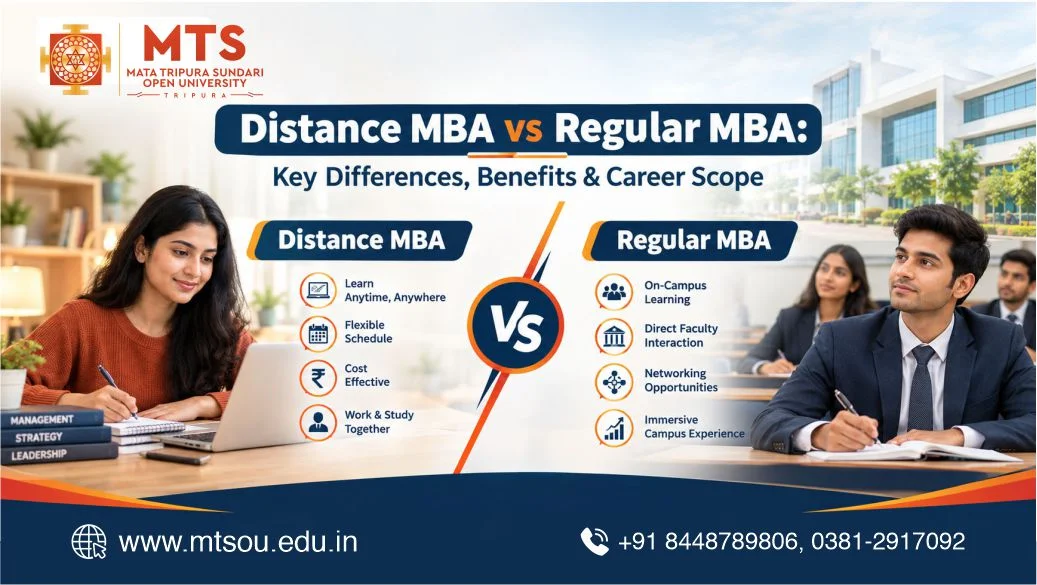 Distance MBA vs Regular MBA: Key Differences, Benefits & Career Scope
While deciding on the distance or regular MBA, a candidate has to keep in mind several factors like
