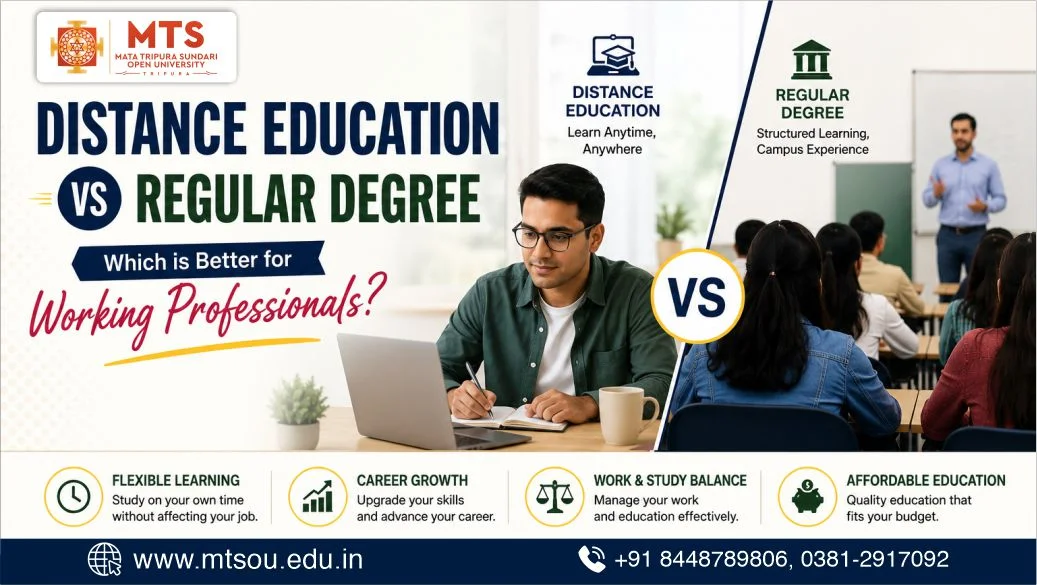
Distance Education vs Regular Degree: Which is Better for Working Professionals?
In today’s competitive world, for career growth and professional success, continuous learning and education are vital, even while maintaining one's job. Having a higher education is crucial for career progression, skill development, and achieving career. In this context, both distance education and regular degree programs have their own advantages and limitations. Working professionals need to upgrade their qualifications without leaving their jobs, but the choice depends on aspects such as flexibility, affordability and time management.
Work, family and education can be a challenge for many professionals. It is here that distance education has become more popular in India. The rise of digital learning platforms and government-recognised ODL Programs empowers learners to pursue their education with greater ease, while also taking care of their careers.
Meanwhile, degree programs are running as usual; they offer classroom instruction and direct contact/campus experiences which many students appreciate. In order to make an informed choice, it is crucial to understand the difference between the two learning approaches and make the correct career decision.
Understanding Distance Education and Regular Degree Programs
In distance education, students can study without attending physical classes. Study materials are delivered either online or offline and can be studied at a convenient pace. Most universities now provide platforms, recorded lectures, online assessments and virtual classrooms. ODL Programs make education accessible for students who cannot attend college due to work, financial or personal obligations.
On the other hand, in a regular degree program, students physically attend lectures, seminars, practical sessions, and campus activities, providing face-to-face interaction with teachers and classmates. For working professionals, attending college can be challenging due to fixed schedules and work commitments.
Both the Distance Education and Regular Degree Program shall be compared on various aspects as below:
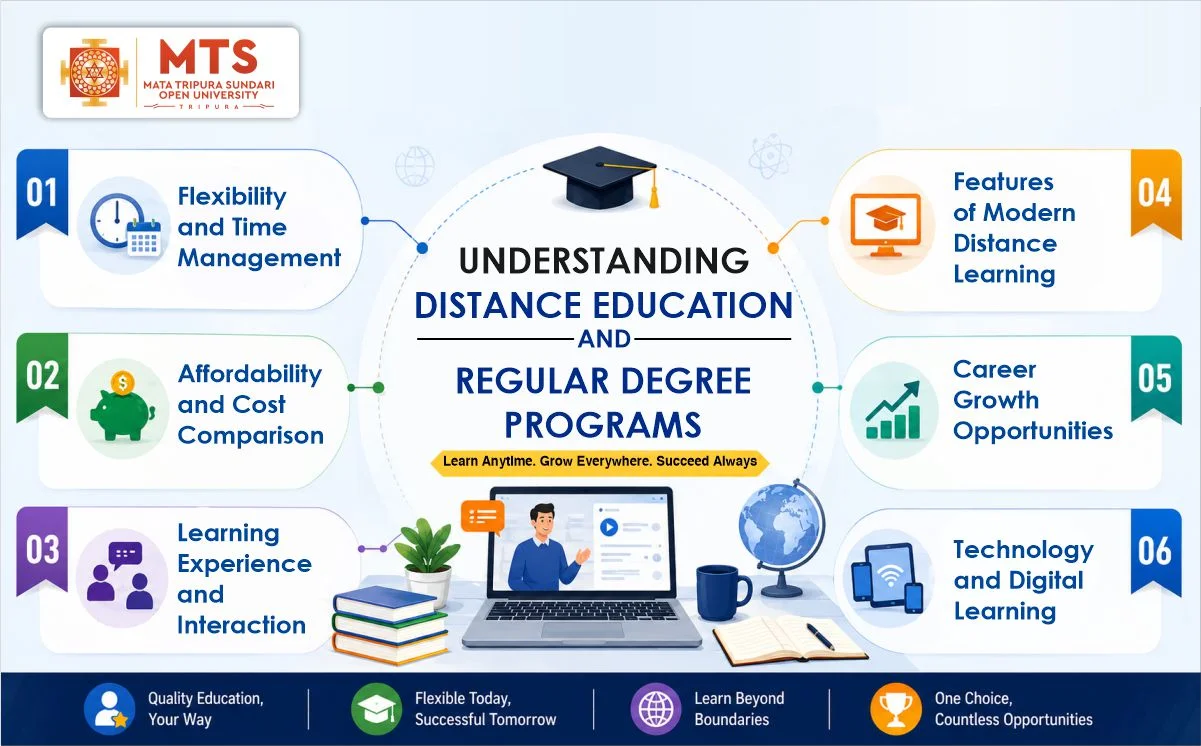
Flexibility and Time Management
The Flexible Learning Program allows students to study according to their schedule without affecting their other obligations. Working professionals get access to lectures through recorded sessions anytime after office hours and complete the assignments at their convenience. Distance education allows learners to study at their own pace,
Benefits of Distance Education
- Flexible study schedules
- Learning from any location
- Access to study materials anytime
- No daily travel to college
- Ability to continue full-time employment
- Self-paced learning environment
This flexibility makes ODL Programs highly suitable for working professionals, entrepreneurs, homemakers and remote learners.
On the other hand, regular degree programs follow fixed schedules that may conflict with office timings. Attending classes becomes difficult for employees who work full-time. Regular degree programs demand fixed attendance and strict schedules, which may not suit employees with demanding jobs.
Read Also - Open Distance Learning in India: A Smart Career Growth Option for Working Professionals
Affordability and Cost Comparison
Another important factor is affordability. Generally, distance education in India is more affordable than regular classroom education, with instalment payment options and scholarships for eligible students.
Advantages of Distance Education Costs
- Lower tuition fees
- Flexible installment payment options
- Reduced transportation expenses
- No hostel or accommodation costs
- Access to digital study materials
- Scholarships for eligible students
Students save time and money because they have the option to study from home. This is a cost-effective solution for working adults who have deep responsibilities at home and work, and find it convenient to learn online and from a distance.
However, there are other costs associated with having a regular degree, including:
- Higher tuition fees
- Room and board fees
- Daily commuting expenses
- Campus activity fees
- Transportation costs
A reputable ODL Program may be the more viable and manageable route for those professionals who are looking to advance their careers but don't want to incur the financial strain of a traditional classroom environment.
Learning Experience and Interaction
Regular degree programs provide physical interaction with professors and classmates during classroom participation, which can improve communication skills and teamwork.
Benefits of Regular Degree Programs
- Direct interaction with teachers
- Classroom participation
- Access to campus facilities
- Practical training sessions
- Student networking opportunities
However, modern distance education programs are rapidly improving their learning experience through technology. Face-to-face interaction is less in distance learning, so to compensate,
Features of Modern Distance Learning
- Live virtual classes
- Recorded video lectures
- Online discussion forums
- Interactive assignments
- AI-based learning platforms
- Digital libraries
- Online mentorship sessions
These features make an Open and Distance Learning Program more engaging and effective than before.
Read Also - Open and Distance Learning Courses: Myths vs Reality for Career Growth
Career Growth Opportunities
Many professionals pursue education mainly for promotions, salary increases or career changes. In this area, both regular and distance education can provide opportunities if the university is recognized.
Today, employers increasingly accept degrees earned through reputed distance education programs. Government-approved ODL Program degrees are considered valid for both public sector jobs.
For professionals who cannot leave their jobs to pursue distance learning courses, continuing employment allows them to gain work experience and education simultaneously, leading to significant career growth.
Regular degree programs may offer campus placement opportunities, but experienced professionals usually benefit more from practical work exposure combined with flexible education.
Technology and Digital Learning
Today’s distance education in India uses digital tools that make learning interactive and convenient.
Digital Features in ODL Programs
- Mobile learning applications
- E-books and digital libraries
- Recorded video lectures
- Online examinations
- Virtual classrooms
- Learning management systems
These innovations have improved the quality of Open and Distance Learning Program models across the country.
While Regular degree courses still rely heavily on classroom teaching, Distance and online learning is still evolving and is now supported by modern technology and digital resources.
Which Option is Better for Working Professionals?
The answer depends on needs, career goals, learning preferences and lifestyle.
A Regular Degree Program is Suitable For:
- Full-time students
- Learners who prefer classroom interaction
- Students seeking campus life and activities
- Individuals interested in practical classroom exposure
Distance Education is Ideal For:
- Working professionals
- Entrepreneurs
- Homemakers
- Remote learners
- Individuals with financial or time limitations
For professionals aiming to balance work and education a recognized ODL Program often becomes the more practical choice.
Many learners who start with distance education courses after 12th continue their studies through online and distance learning because of its convenience and affordability.
Read Also - Top 10 Open Universities in India for Distance Education
Why Choose MTS Open University for Distance Education in India?
Mata Tripura Sundari Open University ( MTS Open University) is a leading open university in India that offers flexible and affordable distance education Courses for students and working professionals. The university supports learners to continue in their higher education through quality study materials, digital learning support and career-oriented ODL courses, which do not affect the employment or personal commitments of the learners.
Conclusion
To summarise, both regular degree programs and distance education programs have their own advantages and limitations. Regular classroom education is structured learning, face-to-face interaction, and distance education is flexible, affordable and convenient.
For working professionals, distance education in India is an effective approach for working professionals to balance their education, career and personal responsibilities. The development of digital learning technology and governmentally recognised ODL Programs has helped to empower professionals to further their education while also obtaining valuable work experience.
Mode of education will be a decision based on an individual's objectives, career choices and lifestyle preferences. Distance education may be the best alternative, however, for those who want to pursue further education and career growth without relocating from their current employers.

RECENT BLOGS
 ODL Admission 2026: Eligibility, Documents, Application Process & Important Steps
Open and Distance Learning (ODL) MTSOU offers distance and open learning courses to students, providing them with
 BBA Distance Education: Complete Guide to Course, Benefits & Career Opportunities
BBA Distance Education is a flexible undergraduate management program for students who wish to pursue business administration
 Mizoram University ODL vs MTSOU ODL: Courses, Fees & Key Differences
Open and Distance Learning (ODL) has increasingly become a viable choice for those individuals desiring to pursue their
