Email info@mtsou.edu.in
Call +91 8448789806
Open BCA

Open and Distance Learning B.C.A. Admission

Enroll immediately in the three-year Bachelor of Computer Application (BCA) program at Mata Tripura Sundari Open University (MTSOU). This is UGC recognized, which is ideal choice for fresh students, working professionals, and distance learners looking for flexible, cost effective and job opportunities in line with present industrial requirement will find this programme suitable.

Earning a B.C.A. from the Open University is a flexible learning option that may be accessed from any geographic area across the world, depending on your goals, circumstances, and lifestyle. Due to its reputation for flexible education, Mata Tripura Sundari Open University (MTSOU) is the ideal option for stay-at-home wives, students preparing for competitive exams, and working professionals.

Mata Tripura Sundari Open University offers BCA undergraduate distance education programme covers the latest syllabus including AI, Cyber Security, Data Science, and Digital Marketing. The curriculum of the BCA programme is aligned with the current market scenario. Our BCA programme prepares students for careers in diverse fields in the evolving digital economy.

Key Features of B.C.A. Course at MTS Open University

  • MATA Tripura Sundari Open University is Recognized by UGC- DEB
  • Students are supported with quality Self-Instructional Material
  • Provision of Multiple Entry and Exit Option
  • Introduction of latest Technology for teaching and learning process through Digital Platform

Eligibility for Distance B.C.A. Admission in Tripura

10+2 pass from any recognized board in India or equivalent is required. No age limit.

Important Dates

  • Commencement of the Admissions / Re – Registration: 16th August, 2025
  • Distribution of Self Learning Material (SLM) : From the 16th October, 2025
  • Commencement of the Weekend Theory and Practical Classes: From 25th October, 2025
  • Conduct of End Semester Examination : From the 16th February,2026
  • Declaration of Result: 15th of March 2026

How to Apply for B.C.A. Program in Agartala, Tripura from MTS Open University?

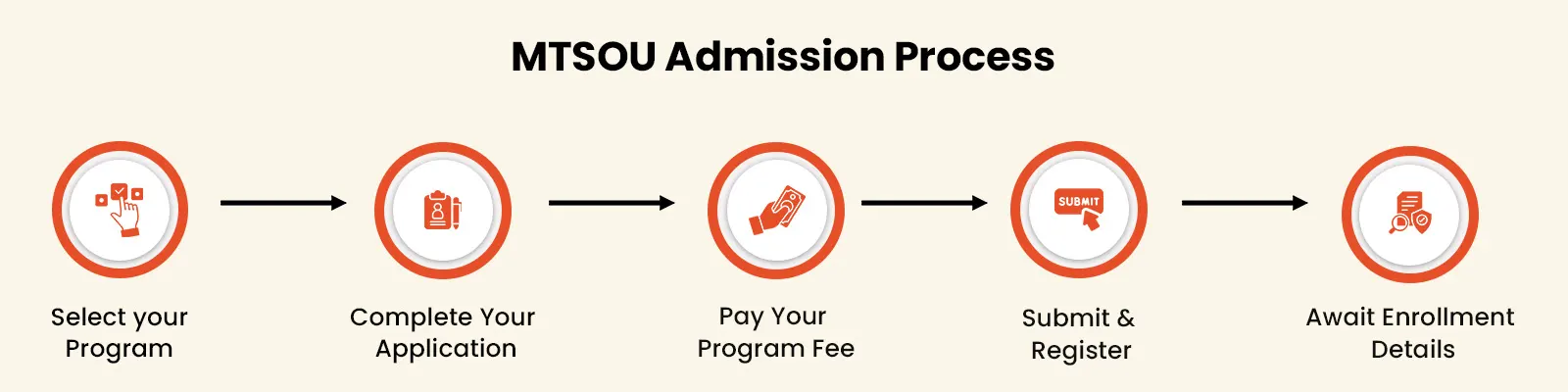
  1. Examine the Prospectus: Download the prospectus here, and select a course.
  2. Register Online: Click "New Admission" on the Admission Portal. Make a password and user ID
  3. How to Register: Enter your information, select just one course, and, if necessary, save the form as a draft.
  4. Upload Files: Upload your mark sheet (within the allowed size), passport photo, and signature in both Hindi and English.
  5. Pay Application cost: Fill out the online form and make the non-refundable admission cost payment.
  6. Print & Verification: Print the application and bring the original paperwork to MTS Open University on the specified date.
  7. Print & Verify: Until verification is completed, admission is tentative. Inaccurate information could result in rejection.
  8. Important: Admission is provisional; any inaccurate information in the application will be summarily rejected

Who Should Apply?

  • Students who are not given opportunity in Formal Educational System.
  • Anyone who wants to finish their B.C.A. programme remotely
  • Professionals looking for an opportunity to upgrade their qualifications

Contact for Admission Assistance

For guidance on B.C.A. admission process in Tripura, contact:

Helpline:   +91 8448789806
Email Id:   admissions@mtsou.edu.in

For more details, download the B.C.A. Prospectus 2025 or apply now.

Bachelor of Computer Application (BCA) - Full Programme Details

B.C.A. Admission Eligibility

10+2 from any recognized board

B.C.A. Course Duration

3 years

Medium of Instruction

English

Fee Structure

Year Registration Fee Programme Fee/Year Exam Fee/Year Total (in Rs.)
1100012000200015000
2Nil12000200014000
3Nil12000200014000
Total43000
B.C.A. Admission Open For Session 2025-26
Apply Online

Credit Requirement for the Award of Degree (as per NEP-2020)

Type of CoursesCredits (3-Year UG)
Major (Core)60
Minor Stream24
Interdisciplinary09
Ability Enhancement Courses (AECs)08
Skill Enhancement Courses (SECs)10
Value Added Courses (VACs)06
Summer Internship03
Total120

Programme Structure Table (Semester-wise)

Semester DSC/Core Courses Minor Courses IDC AECs (Language) SECs / Internship / Dissertation VACs Total Credits
I2 Courses (8 C)2 Courses (8 C)-1 Course (2 C)1 Course (2 C)-20
II2 Courses (8 C)2 Courses (8 C)-1 Course (2 C)1 Course (2 C)-20
III2 Courses (8 C)1 Course (4 C)1 Course (2 C)1 Course (2 C)1 Course (3 C)1 Course (3 C)20
IV2 Courses (8 C)1 Course (4 C)-1 Course (2 C)1 Course (3 C)1 Course (3 C)20
V4 Courses (14 C)-2 Courses (6 C)---20
VI4 Courses (14 C)-1 Course (3 C)-Internship (3 C)-20
Total120

Enhancement modules (SEC, AEC, IDC, VAC)

Skill Enhancement Courses (SECs)
S. No. Name of the Course Course Code
1Fundamentals of Computer System and Office AutomationCSB-1101
2ReasoningMMB-1101
3अनुवाद विज्ञान एवं व्यवहारिक अभ्यासHNB-2113
4लेखन-कौशल (पत्र और निबंध लेखन)HNB-2213
5Public speaking and presentation skillsENB-2113
6Technical WritingENB-2213
7Book Publication CourseSOB-2113
8Indian Tribal & Folk ArtSOB-2213
9Legislative Practices and ProceduresPLB-2113
10Democratic Awareness with Legal LiteracyPLB-2213
11Contemporary Economic IssuesECB-2113
12Data AnalysisECB-2213
13Short introduction of Archives and RecordsHSB-2113
14Culture, Ethics and Values in Ancient Indian TraditionHSB-2213
Ability Enhancement Courses (AECs)
S. No. Name of the Course Course Code
1English CommunicationENB-1101
2Creative WritingENB-1201
3Personality developmentENB-2101
4Basic Knowledge of English GrammarENB-2201
5रचना एक और समाचार लेखनHNB-1101
6फीचर और मीडिया लेखनHNB-1201
7पटकथा लेखनHNB-2101
8कार्यालयी लेखनHNB-2201
Interdisciplinary Courses (IDCs)
S. No. Name of the Course Course Code
1साहित्य और सिनेमाHNB-3115
2भाषा शिक्षणHNB-3116
3समकालीन कविता में पर्यावरणीय चेतनााHNB-3215
4Literature and EcologyENB-3115
5Feminist LiteratureENB-3116
6Literature and FilmsENB-3215
7Gender StudiesSOB-3114
8Development, Social Policy and PlanningSOB-3115
9Sociology of HealthSOB-3214
10Political SociologyPLB-3115
11Political EconomyPLB-3116
12Political PhilosophyPLB-3215
13Environmental EconomicsECB-3115
14Economics of EducationECB-3116
15Mathematical Methods in Economics–IECB-3215
16History and Sociology - Indian SocietyHSB-3115
17History and Political Science - Development of Indian ConstitutionHSB-3116
18History and Literature - Ancient Indian Buddhism, Jainism, Vedic Literature and Ancient Indian Languages and Scripts.HSB-3215
Value-Added Courses (VACs)
S. No. Name of the Course Course Code
1Environmental EducationVAC-2101
2Understanding IndiaVAC-2201

Bachelor of Computer Application (BCA) - Course Syllabus

Semester I
S.N. Course Code Course Name Category Credits Continuous Assessment Marks Term End Exam Marks Grand Total
1. CSB-1111 Management Information System Major 4 30 70 100
2. CSB-1112 Problem solving Using ‘C’ Major 2 30 70 100
3. CSB-1113 Minor 4 30 70 100
4. CSB-1114 Minor 4 30 70 100
5. ENB-1101 English

Communication
AEC 2 30 70 100
6. CSB-1101 Computer Fundamental & Office Automation SEC 2 30 70 100
7. CSB-1151 Problem solving Using ‘C’ Lab Major 2 30 70 100
Total 20 210 490 700

Note: Students are advised to opt Minor courses as given in the evaluation scheme. However, student is free to opt any other minor courses (as offered by the other departments) as per his/her interest/choice.

List of Minors
CSB-1113 Mathematics-I
CSB-1114 Financial Accounting
Semester II
S.N. Course Code Course Name Category Credits Continuous Assessment Marks Term End Exam Marks Grand Total
1. CSB-1211 System Analysis & Design Major 4 30 70 100
2. CSB-1212 C++ & Data Structure Major 2 30 70 100
3. Minor 4 30 70 100
4. Minor 4 30 70 100
5. ENB-1201 Creative Writing AEC 2 30 70 100
6. SEC-1201 Reasoning SEC 2 30 70 100
7. CSB-1251 C++ & Data Structure Lab Major 2 30 70 100
Total 20 210 490 700
List of Minors
CSB-1213 Ordinary Differential Equations
CSB-1214 Fundamentals of Electronics
Semester III
S.N. Course Code Course Name Category Credits Continuous Assessment Marks Term End Exam Marks Grand Total
1. CSB-2111 Computer Organization Major 4 30 70 100
2. CSB-2112 Operating System Major 2 30 70 100
3. Minor 4 30 70 100
4. ENB-2101 Personality Development AEC 2 30 70 100
5. VAC-2101 Environmental Education VAC 3 30 70 100
6. CSB-2114 Computer Based Numerical Methods SEC 3 30 70 100
7. CSB-2151 Operating System Lab Major 2 30 70 100
Total 20 210 490 700
List of Minors
CSB-2113 Integral Calculus
Semester IV
S.N. Course Code Course Name Category Credits Continuous Assessment Marks Term End Exam Marks Grand Total
1. CSB-2211 Analysis and Design of Algorithms Major 4 30 70 100
2. CSB-2212 Object Oriented Programming with Java Major 2 30 70 100
3 Minor 4 30 70 100
4. CSB-2214 Database Management System SEC 3 30 70 100
5. ENB-2201 Basic Knowledge of English AEC 2 30 70 100
6. VAC-2201 Understanding India VAC 3 30 70 100
7. CSB-2251 Object Oriented Programming with Java Lab Major 2 30 70 100
Total 20 210 490 700
List of Minors
CSB-2213 Matrix Theory
Semester V
S.N. Course Code Course Name Category Credits Continuous Assessment Marks Term End Exam Marks Grand Total
1. CSB-3111 Software Engineering Major 4 30 70 100
2. CSB-3112 Computer Networks Major 4 30 70 100
3. CSB-3113 Theory of Computation Major 4 30 70 100
4. CSB-3114 Perspective of Physics Interdisciplinary 3 30 70 100
5. CSB-3115 Basic Abstract & Linear Algebra Interdisciplinary 3 30 70 100
6. CSB-3151 Software Engineering Lab Major 2 30 70 100
Total 20 180 420 600
Semester VI
S.N. Course Code Course Name Category Credits Continuous Assessment Marks Term End Exam Marks Grand Total
1 CSB-3211 IoT & Cloud Computing Major 4 30 70 100
2 CSB-3212 Machine Learning Using Python Major 4 30 70 100
3 CSB-3213 Discrete Mathematics Major 4 30 70 100
4 CSB-3214 Concepts of Physics Interdisciplinary 3 30 70 100
5 CSB-3251 Machine Learning Using Python Lab Major 2 30 70 100
6 CSB-3291 Internship SEC 3 30 70 100
Total 20 180 420 600

Exit Options

  • After 1 Year (40 credits): UG Certificate
  • After 2 Years (80 credits): UG Diploma
  • After 3 Years (120 credits): UG Degree

MOOCs

MOOCs especially those offered by UGC approved platforms like SWAYAM allow students earn credits that can be transferred to their ABC account

MOOCs allow learners to start and stop their learning journey at their convenience, earning credits for completed courses and accumulating them towards a certificate, diploma and degree

Syllabus and Course Materials

Learning Material are developed by experienced prominent Academics who have expertise in their own area of specialization. The syllabus and curriculum are periodically reviewed by Centre for Internal Quality Assurance to maintain the quality of education

Chat with us on WhatsApp