
A distance MBA offers a flexible study option that does not require regular campus attendance for the delivery of the course. A normal MBA is based in a classroom setting on campus. Distance programmes are suitable for employed people or those with other commitments, while a usual MBA provides face-to-face contact with the lecturers and other students on campus, along with campus life.
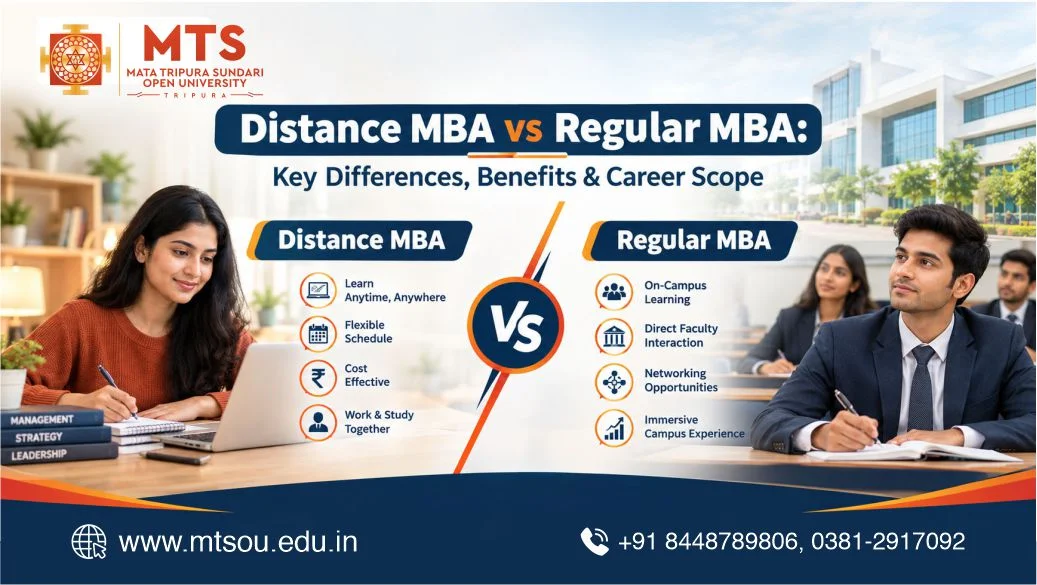
Distance MBA vs Regular MBA: Key Differences, Benefits & Career Scope
Table of Contents
While deciding on the distance or regular MBA, a candidate has to keep in mind several factors like the student's learning style, future aims, budget, availability of time, etc. Both distance MBA and regular MBA courses offer management education, but they differ in terms of mode of delivery, campus life, flexibility, and fee structure. A distance MBA vs regular MBA comparison can therefore be helpful for graduates and working executives in choosing the most appropriate programme.
What Is a Distance MBA?
A Distance MBA is a postgraduate management program aimed at students seeking a flexible way of studying without going to a university daily. Student learning materials, student assessment, university support and academic resources are provided through a distance learning/flexible learning method (subject to the university).
A distance MBA course is especially relevant for working professionals and learners who require attending to work or other pursuits while pursuing education. The students are advised to verify the current eligibility, courses of study, learning process and prospective recognition from the institution.
What Is a Regular MBA?
A Regular MBA is mostly offered on a campus-based learning basis, where the students attend a predefined schedule of classes and have face-to-face contact with the professors as well as fellow students. However, the nature of learning remains formal and classroom-driven. There are classroom discussions, presentations, team activities, etc. Involved in the process.
This mode of delivery is suitable for students who wish to undertake face-to-face teaching in a traditional university environment. In addition, students can choose to join university activities where available, varying according to the institution.
Read Also - Top 10 Open Universities in India for Distance Education
Distance MBA vs Regular MBA: Key Differences
The distance MBA and regular MBA can be explained by considering the following aspects: the learning format, the flexibility, the costs involved, and the experience on campus.
Learning Mode & Flexibility
Distance MBA programs tend to be more flexible, as students/learners do not need to go to campus to attend their classes. These may be suitable for many working students and students from other disciplines.
Standard MBA distance courses adhere to a more predictable, rigid course schedule, with students returning to class on-site to participate in on-campus academic activities.
Fees, Duration & Campus Experience
Most of the Distance MBA programmes are less expensive than a Regular MBA, though tuition fees differ from one college and programme to another. Both programmes can normally be completed in roughly 2 years, depending on your academic background. In addition to being more cost-effective, a Distance MBA offers more flexibility and less travel & stay costs than a Regular MBA. It also provides face-to-face interaction with both faculty members and classmates for active learning through in-class discussions, projects, workshops, and seminars.
| Factor | Distance MBA | Regular MBA |
|---|---|---|
| Learning Mode | Flexible / distance-based | Campus-based |
| Fees | Generally lower | Generally higher |
| Duration | Around 2 years | Around 2 years |
| Campus Experience | Limited | Direct |
| Flexibility | Higher | Structured |
| Daily Attendance | Not Required | Usually required as per the institutional schedule |
| Suitable For | Working professionals and flexible learners | Students seeking classroom-based learning |
Should evaluate the differences in fees, duration, flexibility, and campus experience in order to choose the MBA type best aligned to her academic and professional aspirations.
Benefits of a Distance MBA
Of the distance MBA benefits, flexibility is perhaps the most important. Students can structure their studies to fit in with careers and family life.
Other potential benefits include:
- Flexibility for working professionals
- Reduced need for daily campus travel
- Opportunity to continue working while studying
- Access to learning materials through flexible formats
- Ability to develop management knowledge alongside professional experience
Nevertheless, the students will have to be self-disciplined and manage their time properly in order to sustain smooth progress.
Read Also - Distance Education vs Regular Degree: Which is Better for Working Professionals?
Benefits of a Regular MBA
An Executive MBA is rigorous and stimulating, but it is also experiential. It takes place in a classroom where you can have face-to-face contact with the faculty and your fellow participants, such as in discussion groups, presentations, team tasks, seminars, and other on-campus events.
Key advantages may include:
- Face-to-face interaction with faculty
- Regular classroom structure
- Peer networking opportunities
- Campus-based activities
- Collaborative learning experiences
This approach might suit students who thrive on a regular, structured academic schedule and face to face interaction in the classroom.
Career Scope After an MBA
The distance MBA career scope can cover many business and management fields, depending on a candidate's skills, experience, specialisation and employer's needs. MBA candidates can have career options in domains like marketing, sales, human resources, finance, operations, business development and administration.
| Career Area | Example Roles |
|---|---|
| Marketing | Marketing Executive, Brand Associate |
| Finance | Financial Analyst, Finance Associate |
| Human Resources | HR Executive, Recruiter |
| Operations | Operations Executive, Process Associate |
| Sales | Sales Executive, Business Development Executive |
| Business Development | Business Development Executive, Business Development Associate |
| Administration | Administrative Executive, Management Executive |
An MBA does not promise you a certain position or payment. Advances in your career are achieved through work experience, skills, results, sector and position.
Read Also - Top 5 Highlights to Choose MBA Distance Education from MTS Open University in India
Why Choose MTS Open University for a Distance MBA?
MTS Open University is one of the best distance education universities in India for students seeking a flexible post-graduate management programme. Students should check the current MBA details, eligibility criteria, programme structure, duration, fees, application procedure and recognition of the university prior to choosing a programme.
Formal mode of distance learning is convenient for the students who would like to study while continuing to work or remaining committed to family. Equalising the institutional package with your career goals thus enables you to make an appropriate decision.
Conclusion
An individual has to decide between a distance and regular MBA on the basis of his/her individual circumstances. If an individual is working, a distance MBA will be more convenient. If an individual wants to undergo classroom training, a regular MBA is better.
Distance MBA in India options comparison requires analysing the eligibility criteria, costs involved, program content, mode of learning, authority of the educational institute, student support and career aspirations. Students need to compare the various formats and select the one best suited to their career, schedule and educational aspirations.
Frequently Asked Questions
Is a distance MBA as valuable as a regular MBA for career growth?
The value of an MBA varies according to the reputation of the business school, the programme, skills, experience, and employer requirements. A well-respected distance learning MBA can add value to your career, particularly if you need a qualification to complement current experience while in employment. A 'normal' MBA might be more useful with regard to campus networking, internships, and classroom experience.
What are the main benefits of pursuing a distance MBA?
The key advantages of a distance MBA are convenience, affordability, and avoiding the need to look after their education while they are at work. Students will not need to attend campus on a daily basis and may be able to cut costs on commuting and accommodation. It might help working managers gain management expertise and understanding without having to leave their current jobs.
What is the career scope after a distance MBA in India?
Post a distance MBA, the student can get into sales & marketing, corporate sales, human resources, finance & accounts, operations, administration, business development, etc. Career options can vary according to the specialisation, experience, skill set, and employer requirements. A distance MBA can be useful for working professionals who want to move up the ladder or switch to managerial roles.
Is a distance MBA a good option for working Professionals?
Yes, a distance MBA is an option for working professionals seeking higher studies without leaving their employment, as the various aspects of flexible learning will help them pursue their studies effectively, without any disruption to their employment and other commitments. Before undertaking their studies, they need to find out about the eligibility, course contents, mode of learning, acceptability, cost, and academic help.
Can I pursue a distance MBA while working full time?
Of course, the distance MBA programmes are normally planned to be more flexible. So a full-time employee can also choose to undertake the MBA courses by organising his/her study time around his/her working time. Nevertheless, he/she should be aware of the programme's requirements for attendance, assessment, examination, and assignment submission before taking up the programme.

RECENT BLOGS
 Is a Distance Degree Valid for Competitive Exams in India? What Students Should Know
A distance degree for competitive exams is a feasible way for students aspiring to pursue higher education along
 ODL vs Online Education: Difference, Eligibility, Exams & Which One Should You Choose?
Understanding the available modes of study can help you choose a programme that fits your schedule and learning
 Can You Pursue an ODL Degree While Working Full-Time? Complete Guide
Yes. It is definitely possible to study while working with an ODL programme. Distance education while working